

Dental Implant in Johor Bahru: Cost, Procedure, Benefits and Treatment Options
A missing tooth can affect more than the appearance of your smile. It may make chewing difficult, influence your speech, affect your confidence and contribute to changes in the surrounding teeth and jawbone over time. For patients looking for a long-term solution, dental implants are one option worth considering.
At our dental clinic in Johor Bahru, we believe that replacing missing teeth should involve more than restoring appearance. It should also help patients regain comfortable chewing, maintain oral function and support long-term oral health.
A dental implant in Johor Bahru can replace a single missing tooth, several missing teeth or, in suitable cases, support a full-arch tooth replacement. However, the right treatment depends on each patient’s oral health, bone condition, medical history, expectations and budget.
In this comprehensive guide, we explain how dental implants work, who may be suitable for treatment, the procedure and recovery process, the differences between dental implants, dental bridges and dentures, and the factors that influence dental implant cost in Johor Bahru.
What Is a Dental Implant?
A dental implant is an artificial tooth root that is placed into the jawbone to support a replacement tooth. It is commonly made from biocompatible titanium or another suitable implant material that allows the surrounding bone to bond with its surface through a process known as osseointegration.
A complete dental implant restoration generally consists of three components:
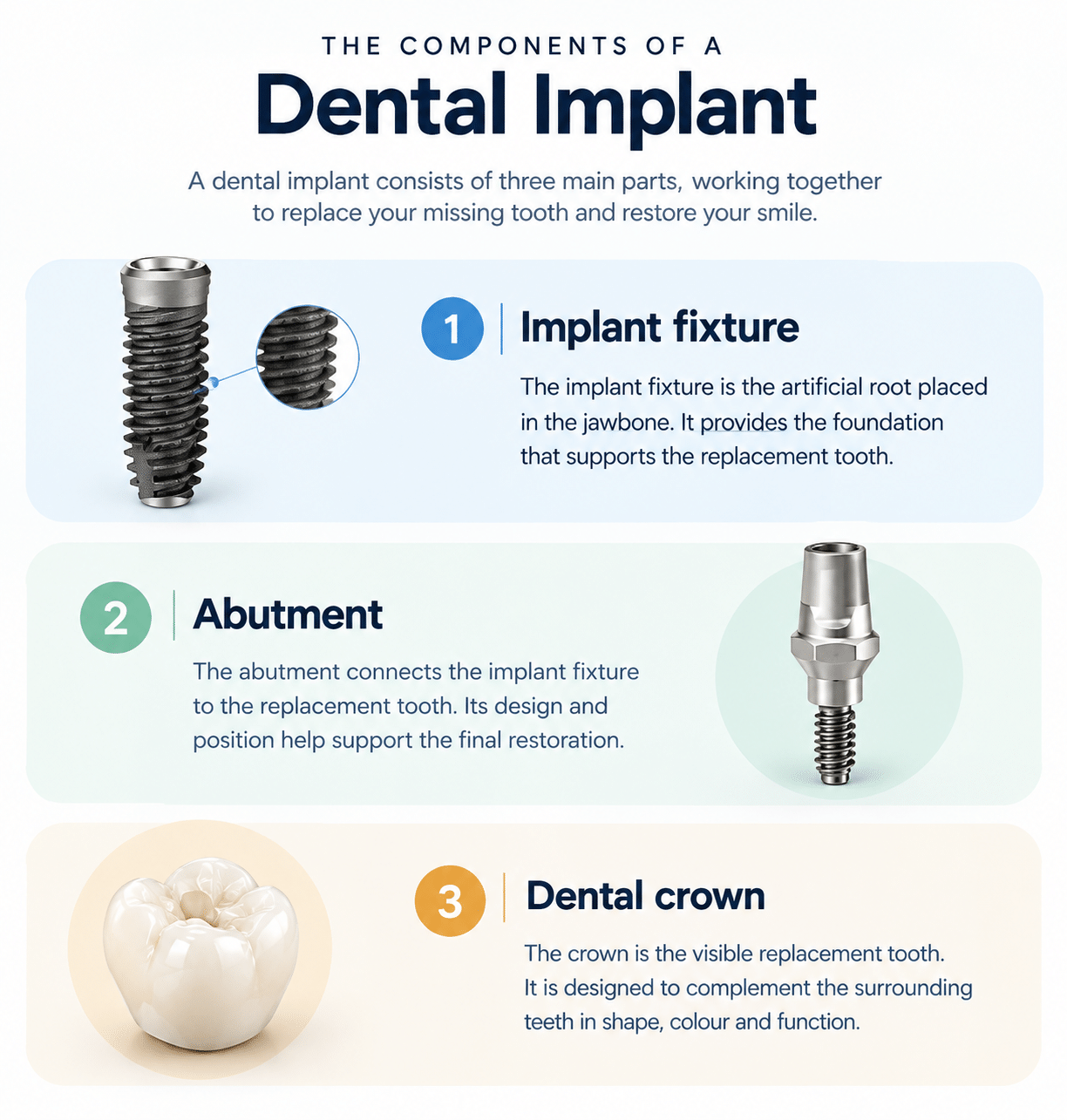
Unlike a removable denture, a conventional implant-supported crown is fixed in place. Unlike a traditional tooth-supported bridge, a single dental implant can replace a missing tooth without requiring the adjacent teeth to serve as supporting pillars. The implant itself also replaces the function of the lost tooth root.
The final appearance and function depend on appropriate treatment planning, implant positioning, the condition of the surrounding tissues and the design of the restoration.
Who Is Suitable for Dental Implants in Johor Bahru?
Dental implants may be suitable for adults who have lost one or more teeth and want a fixed replacement. However, not every patient is immediately ready for implant surgery.
During a dental implant consultation, we assess the patient’s oral health, jawbone, gum condition, medical history and expectations before recommending treatment.
1. Patients Missing One Tooth
A single missing tooth may result from severe decay, a failed root canal treatment, gum disease or an accident. A single-tooth dental implant can replace the missing tooth without relying on neighbouring teeth for support.
This option may be particularly beneficial when the adjacent teeth are healthy and do not require crowns or other restorative treatment.
2. Patients Missing Several Teeth
Patients with several missing teeth may be suitable for multiple dental implants or an implant-supported bridge. The number of implants required depends on the position of the missing teeth, the available bone and the design of the final restoration.
An implant-supported bridge can replace several adjacent teeth without requiring an individual implant for every missing tooth.
3. Patients Who Struggle with Loose Dentures
Traditional removable dentures may move during chewing or speaking, particularly when the supporting jaw ridge has changed over time.
For suitable patients, implant-supported dentures can provide additional retention and stability. Depending on the design, the denture may be removable by the patient for cleaning or fixed and removable only by a dental professional.
4. Patients Who Have Lost Most or All Teeth
Patients with extensive tooth loss may be assessed for a full-arch implant restoration. This treatment uses strategically placed implants to support a full set of replacement teeth.
The number and position of implants, whether the restoration is fixed or removable, and whether preliminary procedures are necessary depend on the individual case.
5. Patients with Adequate Jawbone and Healthy Gums
Successful implant treatment requires careful assessment of the bone available to support the implant and the health of the surrounding gum tissues.
Patients with insufficient bone may still have options, including selected bone augmentation procedures. However, these procedures can increase treatment complexity, cost and healing time.
Active gum disease should generally be controlled before implant placement. A history of gum disease does not automatically rule out implants, but it may increase the need for careful planning and ongoing maintenance.
Can Patients with Diabetes Get Dental Implants?
Patients with diabetes may be candidates for dental implants, but blood glucose control and overall health need to be considered. Poorly controlled diabetes can impair healing and increase the risk of complications.
Patients should disclose their medical conditions and medications during the consultation. We can then determine whether treatment can proceed safely, whether additional precautions are needed or whether treatment should be delayed until the condition is better controlled.
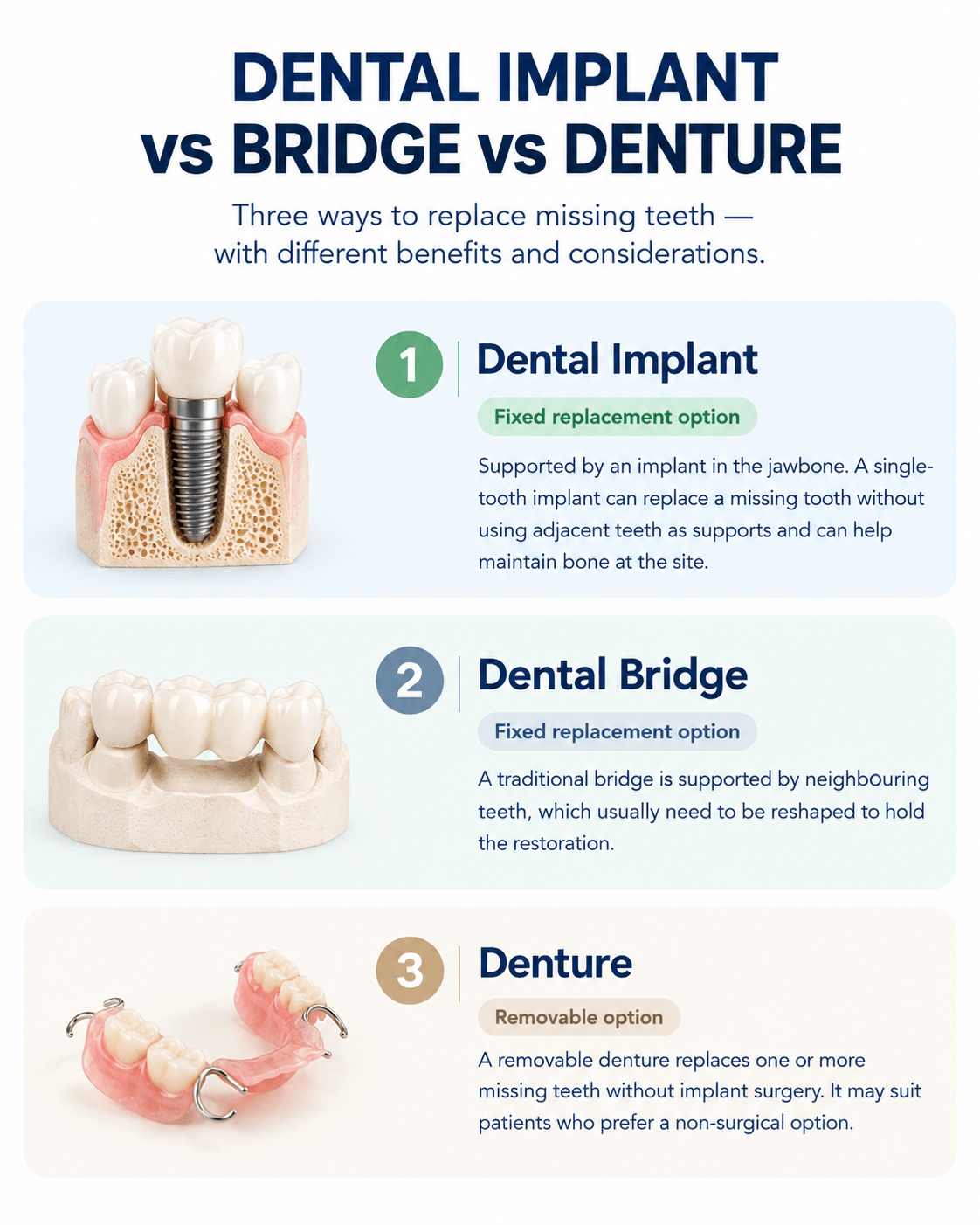

The comparison above describes general characteristics. Actual suitability, longevity, maintenance and cost vary according to the patient’s condition and the type of restoration.
Why Consider a Dental Implant Instead of a Bridge?
For a patient missing one tooth, a dental implant can avoid the need to reshape healthy neighbouring teeth to support a traditional bridge. It also replaces the missing tooth root, whereas a conventional bridge sits above the gum and does not replace that root.
However, a bridge may still be a reasonable choice when adjacent teeth already require crowns, when implant surgery is unsuitable or when the patient prefers a different treatment approach.
Why Consider a Dental Implant Instead of a Denture?
A conventional removable denture rests on the supporting oral tissues and may move during chewing or speaking. An implant-supported restoration gains retention from implants, which may improve stability and confidence when eating and talking.
Nevertheless, implants require surgery, sufficient anatomical support, appropriate healing and continued maintenance. Dentures remain a valid treatment option for many patients, especially when affordability, medical considerations or personal preference are important.
Our recommendation: We assess the condition of the remaining teeth, jawbone, gums, medical history and budget before recommending a treatment. Dental implants may offer important advantages in suitable cases, but they are not automatically the best choice for every patient.
Benefits of Dental Implants
Dental implants offer several potential benefits when they are appropriately planned, placed and maintained.
1. Restore Chewing Function
Missing teeth can make it difficult to bite into certain foods or chew comfortably. A properly designed implant-supported restoration can restore useful chewing function and distribute biting forces through its supporting structures.
The final outcome depends on the number and position of the implants, the restoration design, the opposing teeth and the patient’s ability to maintain the restoration.
2. Improve the Appearance of Your Smile
A missing tooth may create a visible gap, particularly when it affects the front teeth. A dental implant crown can be designed to complement the colour, shape, size and alignment of the surrounding teeth.
Aesthetic planning is especially important in the front of the mouth, where gum contours and the position of the replacement tooth can influence the final appearance.
3. Avoid Using Adjacent Teeth as Supports
A single-tooth implant is supported independently by the jawbone. Unlike a traditional tooth-supported bridge, it does not normally require the adjacent teeth to be reshaped to hold the replacement tooth.
This can be particularly advantageous when the neighbouring teeth are healthy.
4. Help Maintain the Jawbone at the Missing Tooth Site
After a natural tooth is lost, the jawbone in that area can gradually shrink because it no longer receives stimulation through the tooth root.
An implant transfers functional forces to the surrounding bone and can help maintain the bone supporting the implant. However, it cannot guarantee that all bone loss will be prevented, and the bone and gum tissues still require monitoring.
5. Provide a Fixed Alternative to Removable Teeth
A conventional implant crown is not removed by the patient during daily use. For patients who prefer fixed teeth, this can be an important advantage over a removable denture.
Implant-supported full-arch treatments may also provide greater retention than conventional dentures, although the specific benefits depend on the restoration design.
6. Support Long-Term Oral Function
Dental implants can provide long-lasting tooth replacement when the surrounding tissues remain healthy and the restoration is maintained properly. However, implants can develop complications, and the crown or other prosthetic components may eventually require repair or replacement.
Long-term outcomes depend on patient factors, clinical planning, oral hygiene and regular professional maintenance.
Dental Implant Procedure: Step-by-Step Treatment Process
Dental implant treatment involves several stages. Although some cases can be completed more quickly than others, the overall process often takes several months because the implant may need time to integrate with the jawbone before the final restoration is fitted.
Step 1: Initial Consultation and Oral Examination
The process begins with an assessment of the missing tooth or teeth and the patient’s general oral health.
We evaluate the condition of the gums, remaining teeth, bite, available space and any signs of active infection or gum disease. We also review relevant medical conditions, medications, smoking history and previous dental treatment.
This first stage helps determine whether implant treatment is appropriate and whether any preliminary treatment is needed.
Step 2: Dental X-Rays and 3D Imaging
Imaging helps us evaluate the jawbone and the anatomical structures near the proposed implant site. A CBCT (cone-beam computed tomography) scan may be recommended when three-dimensional information is needed for treatment planning.
A CBCT scan can help assess bone dimensions and the location of important structures, such as nerves and the maxillary sinus. It is not required in every case; the choice of imaging depends on the clinical assessment.
Where appropriate, digital planning and surgical guides may be used to help transfer the planned implant position to the surgical procedure.
Step 3: Treatment Planning and Preparation
After reviewing the examination and imaging findings, we determine the proposed implant position, restoration type and treatment sequence.
If necessary, preliminary procedures may include:
-
Treatment of active gum disease.
-
Removal of a tooth that cannot be predictably restored.
-
Bone grafting or other augmentation procedures.
-
Management of infection or other oral health problems.
Not every patient requires these procedures. The treatment plan is tailored to the available bone, gum condition, tooth position and restorative requirements.
Step 4: Dental Implant Placement
Implant placement is a surgical procedure generally performed using local anaesthesia. The clinician prepares the implant site and places the fixture into the planned position in the jawbone.
The technique depends on the patient’s anatomy and the complexity of the case. Patients may feel pressure or vibration during the procedure, but local anaesthesia is used to manage pain during surgery.
The implant may be left to heal beneath the gum or fitted with a healing component, depending on the treatment plan. A temporary tooth may be possible in selected cases, but it is not appropriate for every patient.
Step 5: Healing and Osseointegration
Following placement, the surrounding bone needs time to integrate with the implant surface. This process is known as osseointegration.
Healing time varies according to bone quality, implant location, the complexity of surgery, general health and whether additional procedures were performed. It commonly takes several months, and longer healing periods may be needed in some cases.
During this period, we monitor healing and advise patients on eating, cleaning and protecting the surgical area.
Step 6: Abutment and Final Crown Placement
When the implant has healed sufficiently and is ready to support the restoration, the abutment and replacement tooth can be fitted according to the treatment plan.
The final crown is designed to fit the available space and complement the surrounding teeth. We assess its appearance, contact with neighbouring teeth and bite before completing the restoration.
For implant-supported bridges and full-arch restorations, the design and fitting process will differ according to the number of implants and the type of prosthesis.
Step 7: Follow-Up and Maintenance
Treatment does not end when the replacement tooth is fitted. Regular reviews allow us to assess the condition of the implant, gums, surrounding bone and prosthetic components.
We also provide guidance on brushing, cleaning between teeth and around the implant, and recognising early signs of inflammation or other complications.
Thinking of Getting Dental Treatment? Get quick advice from us!
Our customer service team is ready to assist you with any questions or to book an appointment.
📲 Click here to chat with us on WhatsApp now and take the first step toward a healthier smile!


