

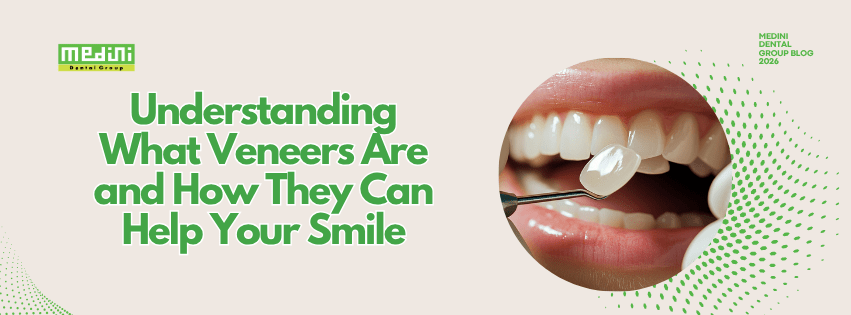
Understanding What Veneers Are and How They Can Help Your Smile
A beautiful smile can influence how we look, speak, and feel about ourselves. When teeth have noticeable stains, chips, uneven shapes, small gaps, or minor imperfections, dental veneers can provide a way to improve their appearance while maintaining a natural-looking smile.
Veneers are one of the most popular cosmetic dental treatments because they can address several aesthetic concerns at the same time. Rather than treating only one specific problem, veneers can help us create a more consistent appearance across multiple teeth.
In this guide, we will explore what dental veneers are, how veneers work, the different types of veneers, their benefits, the treatment process, how long they can last, and who may be a suitable candidate for veneers.
What Are Dental Veneers?
Dental veneers are thin, custom-made coverings designed to be placed over the visible front surfaces of teeth. They are usually made from porcelain or composite resin and are carefully shaped to complement the patient’s facial features, existing teeth, and desired smile.
Unlike a dental crown, which generally covers a much larger portion of a tooth, a veneer primarily changes the appearance of the visible surface.
Veneers can be used to improve the appearance of teeth affected by:
- Discolouration or stubborn staining
- Chipped or worn teeth
- Uneven or irregular tooth shapes
- Small gaps between teeth
- Slightly misaligned-looking teeth
- Teeth that appear too short
- Minor imperfections in tooth surfaces
- Uneven proportions between visible teeth
The goal is not simply to make teeth look perfectly white. A well-planned veneer treatment should create a smile that looks balanced, natural, and appropriate for the individual.
How Do Veneers Improve Your Smile?
One of the main advantages of veneers is their ability to address several cosmetic concerns simultaneously.
For example, someone may have teeth that are slightly different in size, mild staining, small gaps, and chipped edges. Instead of treating each concern separately, veneers can sometimes be incorporated into one comprehensive cosmetic treatment plan.
The dentist evaluates factors such as tooth colour, tooth shape, facial proportions, gum appearance, bite, and smile line before determining an appropriate veneer design.
The result can be a more harmonious smile where the teeth appear more consistent in shape, shade, and proportion.
Porcelain Veneers vs Composite Veneers
There are two common materials used for dental veneers: porcelain and composite resin.
Porcelain Veneers
Porcelain veneers are thin restorations manufactured specifically for the patient’s teeth.
Porcelain is valued for its ability to replicate several characteristics of natural enamel. It can provide a smooth appearance and is generally resistant to staining compared with natural teeth.
Porcelain veneers may be considered when patients want a longer-term cosmetic solution and are suitable candidates for this type of treatment.
Composite Veneers
Composite veneers use tooth-coloured resin that is applied and shaped directly on the tooth by the dentist.
One advantage of composite treatment is that it can often be completed more quickly than laboratory-made porcelain veneers. Composite restorations can also sometimes be repaired or modified more easily.
However, composite resin generally does not have the same stain resistance and long-term durability characteristics as porcelain.
The most appropriate material depends on the condition of the teeth, cosmetic goals, bite, budget, and clinical assessment.
What Problems Can Veneers Correct?
1. Stained or Discoloured Teeth
Some types of tooth discolouration can be difficult to improve with conventional teeth whitening.
Veneers may provide an alternative when the underlying tooth colour does not respond sufficiently to whitening or when we want to improve both colour and tooth shape.
However, veneers are not automatically the best treatment for every type of staining. A dental examination is important to determine the cause of discolouration before choosing cosmetic treatment.
2. Chipped Teeth
Small chips can affect the overall appearance of a smile. Depending on the size and location of the chip, veneers or composite bonding may be considered.
The dentist will also assess why the tooth chipped in the first place. If excessive biting forces or grinding are involved, these factors may need to be addressed to protect the restoration.
3. Small Gaps Between Teeth
Veneers can sometimes be used to improve the appearance of small spaces between front teeth.
However, orthodontic treatment such as braces or clear aligners may be more appropriate when the underlying issue involves significant tooth movement or bite problems.
4. Uneven Tooth Shape
Natural teeth are not always perfectly symmetrical. Some may be shorter, narrower, or differently shaped than neighbouring teeth.
Veneers can help create more consistent proportions where appropriate.
5. Worn Teeth
Teeth can gradually become shorter or worn due to normal ageing, grinding, certain habits, or other dental conditions.
Depending on the cause and severity, veneers may form part of a broader restorative treatment plan.


