

Losing a tooth can affect more than just your smile. It can make eating uncomfortable, affect your speech, and gradually change the appearance of your face. Fortunately, modern dentistry offers a reliable solution through dental implants.
With advancements in dental technology, replacing missing teeth has become more precise and predictable. One of the latest developments is 3D Guided Dental Implant surgery, which allows dentists to plan implant placement digitally before performing the actual procedure.
At Medini Dental Group in Johor Bahru, modern dental technology helps dentists plan implant treatments with greater precision, supporting a more personalised approach to restoring missing teeth.
What Is a Dental Implant?
A dental implant is a small titanium or titanium-alloy post that is surgically placed into the jawbone to replace the root of a missing tooth.
Once the implant integrates with the surrounding bone, it provides a stable foundation for a dental crown, bridge, or other suitable dental restoration.
Unlike traditional dentures, dental implants are designed to stay securely in place without relying on neighbouring teeth for support.
A dental implant generally consists of three main components:
- Implant Fixture: The titanium post placed inside the jawbone to act as an artificial tooth root.
- Abutment: The connector that attaches the implant fixture to the dental crown.
- Dental Crown: The visible part designed to look and function like a natural tooth.
What Is 3D Guided Dental Implant Surgery?
Traditional implant surgery relies on clinical examination, dental imaging, and the dentist’s surgical assessment to determine the ideal implant position.
With 3D Guided Dental Implant technology, the treatment planning process becomes more detailed through digital imaging and computer-assisted planning.
The process typically involves a CBCT (Cone Beam Computed Tomography) scan, which provides a three-dimensional view of the patient’s jawbone, teeth, nerves, and surrounding anatomical structures.
Using specialised dental software, the dentist can assess the available bone and digitally plan the implant’s position, depth, and angulation before surgery.
A customised surgical guide may then be produced to help guide the implant placement according to the treatment plan.
This technology supports a more controlled and carefully planned implant procedure.
How Does 3D Guided Dental Implant Work?
The process generally involves several important stages.
1. Comprehensive Dental Assessment
The first step is a consultation with the dentist. Your oral health, medical history, gum condition, and missing tooth area will be assessed.
The dentist will determine whether dental implants are suitable for your condition.
2. 3D CBCT Scanning
A CBCT scan captures detailed three-dimensional images of your jawbone and surrounding structures.
This allows the dentist to evaluate bone volume, bone quality, and the position of important anatomical structures, such as nerves and sinuses.
3. Digital Implant Planning
Using specialised software, the dentist plans the implant position based on your individual anatomy.
The planning process helps identify a suitable implant position while considering the final appearance and function of the replacement tooth.
4. Customised Surgical Guide
Based on the digital plan, a customised surgical guide may be fabricated.
The guide helps the dentist transfer the planned implant position to the patient’s mouth during surgery.
5. Dental Implant Placement
The implant is placed into the jawbone according to the treatment plan.
After placement, a healing period is usually required for osseointegration, where the implant gradually bonds with the surrounding bone.
6. Final Dental Crown Placement
Once the implant has integrated sufficiently with the jawbone, the dentist can proceed with the final restoration.
A customised dental crown is attached to complete the replacement tooth.
Benefits of 3D Guided Dental Implant Technology
Why are more patients considering digitally planned dental implant treatment?
Here are some potential benefits:
1. More Precise Treatment Planning
Three-dimensional imaging allows dentists to evaluate the jawbone and surrounding structures in greater detail.
This supports careful planning of the implant’s position, depth, and angulation.
2. Better Understanding of Jawbone Structure
A CBCT scan provides a detailed view of the jawbone, helping dentists assess whether sufficient bone is available for implant placement.
If bone volume is insufficient, additional procedures such as bone grafting may be considered.
3. Improved Surgical Guidance
A customised surgical guide helps transfer the digital treatment plan into the patient’s mouth.
This can improve the consistency of implant positioning, although the final outcome still depends on clinical conditions and the dentist’s expertise.
4. A More Personalised Treatment Approach
Every patient’s jawbone structure and dental condition are different.
Digital planning allows the dentist to develop an implant treatment plan based on individual anatomical requirements.
5. Potentially Less Invasive Surgery
In suitable cases, guided implant surgery may allow a flapless or minimally invasive approach.
This may reduce surgical trauma, discomfort, and recovery time. However, not every patient is suitable for this technique.
Who Is Suitable for 3D Guided Dental Implants?
Dental implants may be suitable for adults who have lost one or more teeth and want a stable, long-term replacement option.
You may be a candidate if:
- You have one or more missing teeth.
- Your jawbone has sufficient volume to support an implant.
- Your gums are healthy or any existing gum disease has been treated.
- You are looking for a fixed alternative to removable dentures.
- You are committed to maintaining good oral hygiene.
However, certain conditions may affect implant treatment suitability, including uncontrolled diabetes, active gum disease, smoking, and insufficient jawbone volume.
A proper dental examination is necessary before proceeding with treatment.
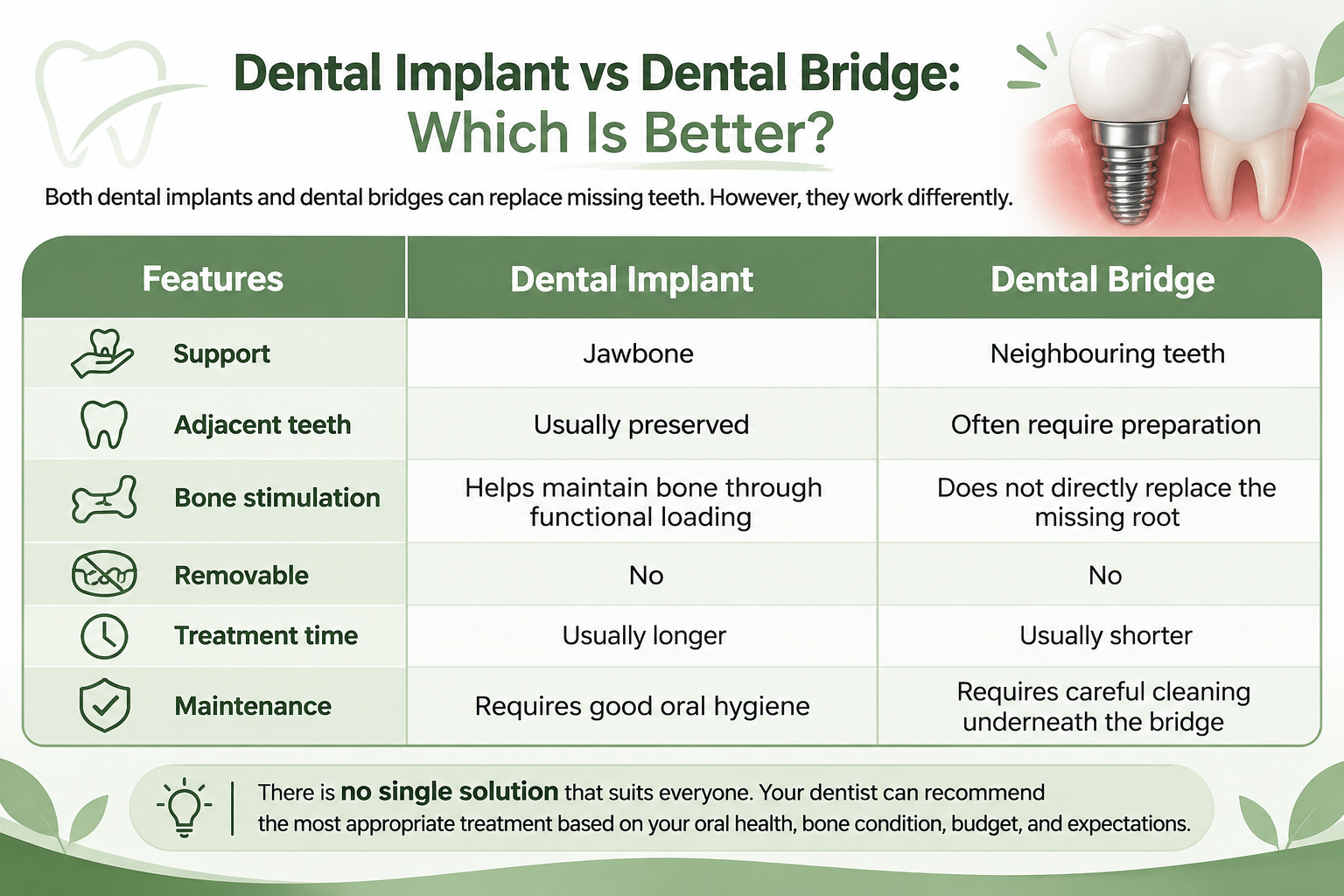
Why Should You Replace a Missing Tooth?
Some people may think that losing one tooth is not a serious problem, especially when it is located at the back of the mouth.
However, leaving a missing tooth untreated may lead to several complications over time.
1. Shifting of Neighbouring Teeth
The surrounding teeth may gradually move towards the empty space, potentially affecting your bite alignment.
2. Difficulty Chewing
Missing teeth can affect your ability to chew food properly, particularly when multiple teeth are missing.
3. Jawbone Loss
When a natural tooth is lost, the jawbone in that area no longer receives normal stimulation from its root.
Over time, this may contribute to bone resorption.
4. Changes in Facial Appearance
Significant tooth and bone loss can contribute to changes in facial support and appearance.
Replacing missing teeth can help restore chewing function and support a healthier-looking smile.
3D Guided Dental Implant at Medini Dental Group, Johor Bahru
If you are considering dental implants in Johor Bahru, choosing an experienced dental team and receiving a proper treatment assessment are important steps.
At Medini Dental Group, patients can explore modern dental implant solutions with treatment planning tailored to their individual needs.
With 3D imaging and digital implant planning, dentists can evaluate the patient’s jawbone structure and plan the implant procedure before surgery.
Our goal is to help patients restore their smiles, improve chewing function, and regain confidence through suitable dental treatment options.
Whether you are missing one tooth, several teeth, or looking for a more stable alternative to dentures, a dental implant consultation can help you understand your options.
Frequently Asked Questions (FAQs)
1. Is 3D Guided Dental Implant surgery painful?
The procedure is generally performed under local anaesthesia, so patients should not feel pain during the implant placement. Some discomfort, swelling, or soreness may occur after surgery and can usually be managed with appropriate medication.
2. How long does a dental implant procedure take?
The implant placement itself may take approximately 30 minutes to a few hours, depending on the complexity of the case. The overall treatment may take several months because the implant needs time to integrate with the jawbone.
3. Is 3D Guided Dental Implant better than traditional implant surgery?
3D Guided Dental Implant surgery offers additional digital planning and surgical guidance. It can improve the precision of implant positioning in suitable cases. However, the best approach depends on the patient’s anatomy and clinical requirements.
4. How long do dental implants last?
Dental implants can last many years, and some may last a lifetime with proper care. However, the crown may need replacement over time. Regular dental check-ups and good oral hygiene are essential.
5. Can I get dental implants if I have insufficient jawbone?
Possibly. Depending on the condition, procedures such as bone grafting or sinus lifting may be recommended to improve the available bone before implant placement.
6. Where can I get dental implants in Johor Bahru?
You can visit Medini Dental Group to arrange a dental consultation and discuss suitable dental implant options, including digitally planned implant treatment.
Restore Your Smile with Modern Dental Implant Technology
Missing teeth should not stop you from enjoying your favourite food or smiling confidently.
With advancements in 3D imaging and guided implant planning, modern dentistry offers more personalised ways to restore missing teeth.
Take the first step towards a healthier, more confident smile.
Book a dental implant consultation with Medini Dental Group, Johor Bahru, and discover whether 3D Guided Dental Implant treatment is suitable for you.
Thinking of Getting Dental Treatment? Get quick advice from us!
Our customer service team is ready to assist you with any questions or to book an appointment.
📲 Click here to chat with us on WhatsApp now and take the first step toward a healthier smile!


