

Tooth Replacement Options After Extraction: Which Is Best for You?
Losing a tooth can affect more than just your smile. Whether a tooth has been removed because of severe decay, gum disease, an infection, or an injury, the gap left behind may affect your ability to chew comfortably, speak clearly, and maintain your confidence. Fortunately, several tooth replacement options after extraction can help restore your smile and oral function.
The most suitable treatment depends on several factors, including the number of missing teeth, the condition of your gums and jawbone, your overall oral health, your budget, and your long-term expectations. The main options include dental implants, dental bridges, and dentures. Each treatment offers different benefits, limitations, and maintenance requirements.
Understanding these options can help you make an informed decision with your dentist and choose a solution that suits your needs.
Why Should You Replace a Missing Tooth After Extraction?
After a tooth is extracted, the surrounding teeth and jawbone may gradually change. Although replacing every missing tooth is not always necessary in every situation, leaving a gap can create functional and dental concerns that should be assessed by a dentist.
1. Prevent Unwanted Tooth Movement
When a tooth is missing, neighbouring teeth may gradually tilt or shift into the space. The opposing tooth may also move towards the gap. These changes can affect your bite and make certain areas more difficult to clean.
Replacing a missing tooth may help maintain the arrangement of your teeth and support a more balanced bite.
2. Maintain Chewing Function
Missing teeth can make it harder to bite and chew certain foods, particularly when several teeth are absent or when the missing tooth is located towards the back of the mouth.
A suitable tooth replacement can improve chewing efficiency and make eating more comfortable.
3. Support Jawbone Health
The jawbone receives stimulation through the forces transmitted by natural tooth roots during chewing. Following tooth extraction, the bone in that area naturally remodels and may gradually lose volume.
Dental implants are designed to replace the tooth root as well as the visible tooth, transmitting functional forces to the surrounding bone. Bridges and conventional dentures replace the visible tooth or teeth but do not provide the same direct stimulation to the jawbone at the missing tooth site.
4. Restore Your Smile and Confidence
A missing front tooth may affect the appearance of your smile, while multiple missing teeth can change lip support and facial appearance. Tooth replacement can help restore a natural-looking smile, although the aesthetic outcome depends on the treatment, the condition of the surrounding tissues, and the design of the replacement teeth.
What Are the Main Tooth Replacement Options After Extraction?
There are three common ways to replace missing teeth: dental implants, dental bridges, and dentures.
The right choice depends on your individual dental condition. We can compare these options by looking at how they work, their benefits, their limitations, and the situations in which they may be appropriate.
1. Dental Implants: A Long-Term Tooth Replacement Option
A dental implant is a small implant fixture, usually made of titanium or another suitable biocompatible material, that is placed surgically into the jawbone. It acts as an artificial tooth root and supports a replacement tooth, commonly a dental crown.
For patients missing a single tooth, a dental implant can replace the missing tooth without requiring the neighbouring teeth to be prepared as bridge supports.
How Does Dental Implant Treatment Work?
Dental implant treatment generally involves several stages.
Step 1: Dental examination and assessment
The dentist evaluates your teeth, gums, medical history, and bite. Dental X-rays and, when indicated, three-dimensional imaging help assess the available bone and the position of important anatomical structures.
Step 2: Treatment planning
The dentist determines whether there is sufficient bone to support an implant and whether additional procedures, such as bone grafting, may be necessary.
Step 3: Implant placement
The implant fixture is placed into the jawbone under appropriate anaesthesia. If the tooth has already been extracted, the dentist assesses whether the implant can be placed immediately or whether a healing period is preferable.
Step 4: Healing and integration
The implant needs time to integrate with the surrounding bone, a process known as osseointegration. The healing period varies depending on the individual case and whether additional procedures are required.
Step 5: Placement of the final restoration
Once the implant is sufficiently stable and the tissues are ready, an abutment and a custom-made crown are fitted to complete the restoration. Some treatment plans use a temporary restoration during healing.
Benefits of Dental Implants
Dental implants offer several advantages:
- They replace the tooth root: The implant provides support within the jawbone.
- They preserve neighbouring teeth: A single-tooth implant generally does not require the adjacent teeth to be prepared for crowns, unlike a conventional bridge.
- They provide stable chewing function: Once fully restored, an implant-supported crown can function much like an individual tooth.
- They can look natural: The crown is designed to complement the surrounding teeth.
- They can provide long-term value: With good oral hygiene, regular dental reviews, and appropriate maintenance, implants can last many years. The crown and other components may still require repair or replacement.
Are Dental Implants Suitable for Everyone?
Not every patient is immediately suitable for dental implant treatment. Adequate bone, healthy or appropriately treated gums, and good oral hygiene are important considerations.
Certain medical conditions, smoking, uncontrolled gum disease, and other factors may affect healing or implant success. These factors require individual assessment rather than automatically ruling out treatment.
Patients with insufficient bone may still be candidates for implants after additional treatment, such as bone augmentation, depending on their circumstances.
How Soon Can a Dental Implant Be Placed After Extraction?
The timing depends on the condition of the tooth socket, the presence of infection, the amount of available bone, and the stability that can be achieved during placement.
There are several possible approaches:
- Immediate placement: The implant is placed at the same appointment as the extraction when the clinical conditions are suitable.
- Early placement: The implant is placed after a short healing period.
- Delayed placement: The extraction site is allowed to heal for a longer period before implant surgery.
Immediate placement is not automatically the best choice for every patient. The dentist must determine which timing offers the most predictable outcome.
2. Dental Bridges: Replace a Missing Tooth Without Implant Surgery
A dental bridge is a fixed restoration that replaces one or more missing teeth by attaching an artificial tooth to supporting teeth or, in some cases, to implants.
A conventional dental bridge commonly uses crowns on the natural teeth beside the gap to support the replacement tooth.
How Does a Dental Bridge Work?
The dentist assesses the teeth adjacent to the missing tooth to determine whether they can support a bridge. For a conventional bridge, the supporting teeth are usually reshaped to accommodate crowns.
An impression or digital scan is then used to fabricate the restoration. Once the bridge is ready, it is fitted and secured in place.
Unlike a removable denture, a conventional bridge remains fixed in the mouth and is not normally removed by the patient.
Benefits of Dental Bridges
Dental bridges may be suitable for patients who want a fixed replacement without implant surgery.
Their benefits include:
- A fixed tooth replacement: The bridge remains in place during normal eating and speaking.
- A shorter treatment timeline in many cases: A conventional bridge can often be completed in a few weeks, depending on the clinical situation and laboratory arrangements.
- No implant surgery: A conventional bridge does not require placement of an implant fixture into the jawbone.
- Restored appearance and function: The artificial tooth can be designed to match the surrounding teeth.
Limitations of Dental Bridges
A conventional bridge also has disadvantages that should be considered.
Healthy neighbouring teeth may need to be reshaped. This is an important consideration when the adjacent teeth are intact and do not otherwise need crowns.
Cleaning beneath the artificial tooth requires specific techniques, such as using floss threaders or suitable interdental cleaning aids.
A bridge also does not replace the missing tooth root. The jawbone beneath the missing tooth may continue to remodel after extraction.
The long-term performance of a bridge depends on the health of its supporting teeth, the quality of the restoration, bite forces, and oral hygiene. If a supporting tooth develops decay or gum problems, the bridge may be affected.
Who May Benefit From a Dental Bridge?
A dental bridge may be appropriate when the neighbouring teeth already have large fillings, extensive damage, or other reasons to require crowns. It can also be considered when implant surgery is unsuitable or when a patient prefers a fixed alternative without surgery.
The dentist should evaluate the supporting teeth carefully before recommending this option.
3. Dentures: A Removable and Often More Affordable Option
A denture is a removable dental appliance designed to replace missing teeth. Depending on the number and position of the missing teeth, it may replace a single tooth, several teeth, or an entire arch.
Partial dentures replace some missing teeth while retaining the remaining natural teeth. Complete dentures replace all the teeth in the upper or lower arch.
How Do Dentures Work?
Dentures are custom-made to fit the contours of the mouth. A partial denture may use clasps or other components to help retain it, while a complete denture relies on the shape of the supporting tissues, the fit of the base, and the surrounding muscles.
After extraction, the gums and jawbone gradually change shape. An immediate denture may be provided around the time of extraction when appropriate, but it may need adjustment, relining, or replacement as healing progresses.
Benefits of Dentures
Dentures offer several practical advantages:
- Lower initial cost in many cases: Conventional dentures are often less expensive initially than implant treatment.
- No implant surgery for conventional dentures: They can be provided without surgically placing an implant.
- Suitable for multiple missing teeth: One appliance can replace several teeth at once.
- Flexible treatment options: Dentures can be designed as temporary or longer-term replacements.
- Potentially faster provision: A conventional denture may be prepared without waiting for implant integration, although fabrication and healing requirements vary.
Limitations of Dentures
Because conventional dentures are removable, they may move during eating or speaking, especially if the fit is poor or the supporting tissues have changed.
Some patients need time to adapt to wearing them. Dentures can also create pressure points and require periodic adjustment.
They do not replace natural tooth roots, and the jawbone beneath the missing teeth may continue to lose volume over time.
Dentures must be cleaned daily and removed as instructed by the dentist. Partial dentures also require careful cleaning around the remaining natural teeth to reduce the risk of plaque accumulation, decay, and gum disease.
Who May Benefit From Dentures?
Dentures may be suitable for patients missing several teeth or all teeth in an arch, particularly when affordability is a major consideration.
They may also be useful as a temporary replacement while the extraction site heals or while a patient considers longer-term treatment.
For patients who struggle with loose dentures, implant-supported dentures may be another option. These use dental implants to improve retention and stability, although they require surgery and additional treatment planning.
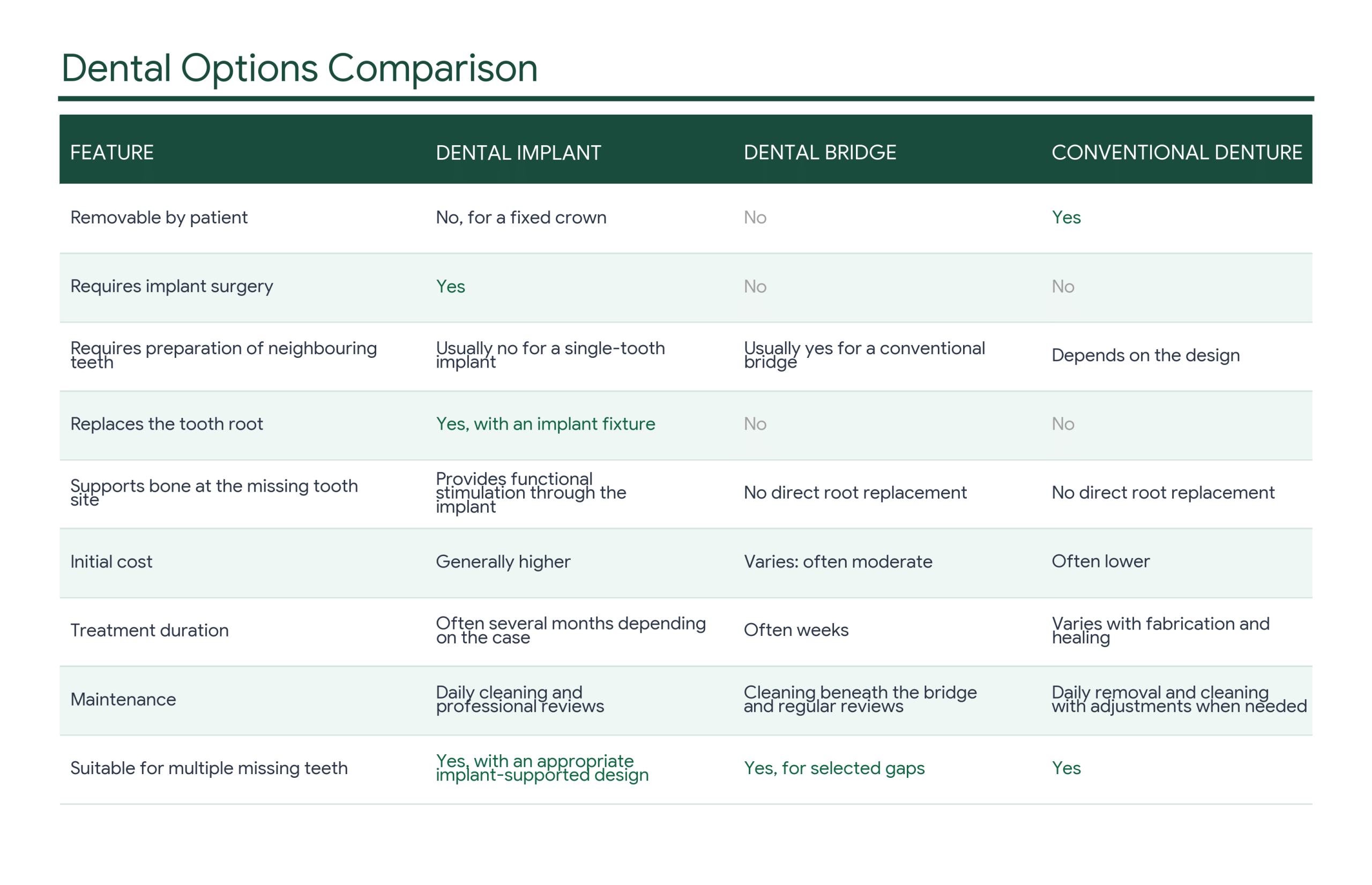
These are general comparisons. Actual treatment time, cost, and suitability vary according to the number of missing teeth, oral health, materials, complexity, and local dental fees.
Which Tooth Replacement Option Is Best for You?
There is no single option that is best for every patient. We recommend considering the following factors when discussing treatment with your dentist.
If You Want to Replace One Missing Tooth
A single dental implant may be worth considering if you have suitable bone and healthy gums. It replaces the missing tooth without normally requiring preparation of the neighbouring teeth.
A dental bridge may be a practical alternative, particularly if the adjacent teeth already need crowns or if implant surgery is not appropriate.
If You Want to Avoid Surgery
A conventional dental bridge or denture may be appropriate if you prefer not to undergo implant surgery.
The choice depends on whether you are replacing one tooth or several teeth, the condition of the neighbouring teeth, and whether you prefer a fixed or removable appliance.
If You Have Several Missing Teeth
Several implants, an implant-supported bridge, a conventional bridge in selected cases, or a partial denture may be considered.
The most suitable solution depends on the distribution of missing teeth, the condition of the remaining teeth, bone availability, and your budget.
If You Have Lost All Your Teeth
Complete dentures are a common option for replacing an entire arch.
Patients seeking greater stability may also be assessed for implant-supported dentures or a fixed implant-supported full-arch restoration. These treatments differ in cost, surgical requirements, maintenance, and the number and positioning of implants required.
If Budget Is Your Main Concern
Conventional dentures generally have a lower initial cost than implant treatment. Bridges may fall between dentures and implants in some cases, although costs vary significantly.
When comparing prices, consider not only the initial treatment fee but also future maintenance, adjustments, repairs, and possible replacement of the restoration.
A dentist can explain the expected costs and alternatives based on your specific treatment plan.
Can You Get a Dental Implant Immediately After Tooth Extraction?
In some cases, yes. A dental implant can be placed during the same appointment as the extraction. This is known as immediate implant placement.
However, immediate implant placement is not suitable for every extraction site.
The dentist must assess the amount and quality of the remaining bone, the condition of the surrounding gum tissue, whether infection is present, and whether sufficient implant stability can be achieved.
Immediate placement also does not necessarily mean that the final crown can be fitted immediately. In some cases, a temporary tooth may be provided, while the implant is allowed to integrate with the bone before the final restoration is placed.
If immediate placement is not appropriate, delayed implant placement may offer a more predictable approach.
What Happens If You Do Not Replace an Extracted Tooth?
The consequences of leaving a gap depend on which tooth is missing, the number of remaining teeth, your bite, and your overall oral health.
Possible changes include neighbouring teeth shifting, the opposing tooth moving into the gap, reduced chewing efficiency, and continued bone remodelling at the extraction site.
However, replacing every missing tooth is not always necessary. For example, some missing wisdom teeth or certain back teeth may not require replacement if they do not compromise function or oral health.
The decision should be based on a dental examination rather than on the presence of a gap alone.
If you are considering leaving a tooth unreplaced, discuss the potential benefits and risks with your dentist.
How Much Does Tooth Replacement Cost After Extraction?
The cost of tooth replacement varies according to the type of treatment, the number of teeth involved, the materials used, and the complexity of the case.
Dental implant treatment may involve several components, including the implant fixture, abutment, crown, imaging, and any additional procedures such as bone grafting.
A dental bridge’s cost depends on the number of units, the materials used, and the condition of the supporting teeth.
Denture costs vary according to the type of denture, the number of teeth being replaced, and whether additional procedures or adjustments are needed.
When comparing treatment quotations, ask what is included in the total fee, whether temporary teeth are provided, how follow-up visits are handled, and what maintenance may be required.
Rather than choosing solely by the lowest initial price, consider the treatment’s suitability, expected function, maintenance requirements, and long-term value.
How to Care for Your Replacement Teeth
Regardless of the option you choose, good oral hygiene and regular dental visits are essential.
Caring for Dental Implants
Brush twice daily with fluoride toothpaste and clean carefully around the implant crown. Interdental brushes or other suitable cleaning aids may help remove plaque around the restoration.
Attend regular dental reviews so the dentist can assess the implant, surrounding gums, bite, and restoration.
Caring for Dental Bridges
Brush the bridge and surrounding teeth thoroughly. Clean underneath the artificial tooth using a floss threader, specialised floss, or another recommended cleaning aid.
Keep the supporting teeth and gums healthy because problems affecting these teeth can compromise the bridge.
Caring for Dentures
Remove and clean dentures daily according to your dentist’s instructions. Clean any remaining natural teeth, gums, and tongue as well.
Avoid using hot water that could distort the appliance. If the denture becomes loose, uncomfortable, or damaged, arrange a dental review rather than attempting to adjust it yourself.
Frequently Asked Questions About Tooth Replacement After Extraction
How long should I wait after extraction before replacing a tooth?
The timing depends on the treatment selected and how the extraction site heals. Some implants can be placed immediately, while others require several weeks or months of healing. Bridges and dentures follow different timelines. Your dentist can recommend an appropriate schedule after examining the site.
Is a dental implant better than a bridge?
A dental implant can preserve the neighbouring teeth from the preparation usually required for a conventional bridge and provides support within the jawbone. However, an implant requires surgery and may involve a longer treatment period and higher initial cost. A bridge may be more suitable when the supporting teeth already need crowns or implant surgery is not appropriate.
Is a denture a permanent solution?
A denture can provide long-term tooth replacement, but it requires ongoing maintenance. Changes in the gums and jawbone can affect its fit, so adjustments, relining, or replacement may be needed.
Can I get a dental implant years after extraction?
Yes, many patients can receive implants years after losing a tooth. However, the jawbone may have changed during that time. A clinical examination and appropriate imaging can help determine whether an implant is feasible and whether additional procedures may be necessary.
Can I replace a missing tooth without surgery?
Yes. Depending on your dental condition, a conventional dental bridge or removable denture may replace a missing tooth without implant surgery.
Do dental implants last a lifetime?
Dental implants can last for many years, but no treatment is guaranteed to last a lifetime. The implant fixture, surrounding tissues, and crown all require maintenance. The crown may wear or need replacement, and complications can occur if oral hygiene is inadequate or other risk factors are present.
What is the most affordable tooth replacement option?
Conventional dentures often have the lowest initial cost, particularly when several teeth are missing. However, the most appropriate option depends on your oral health, functional needs, and long-term maintenance requirements.
Thinking of Getting Dental Treatment? Get quick advice from us!
Our customer service team is ready to assist you with any questions or to book an appointment.
📲 Click here to chat with us on WhatsApp now and take the first step toward a healthier smile!


